#36 Mapping community music
Is the future of music not-for-profit? Can we build better infrastructure for an interdependent "community music layer" in Australia? What would that look like? I have, of course, all the answers.

Alrighty
I went to thing last night that has inspired me to write some stuff, so you can dig into that below. It takes me a bit to warm up, and then there’s a bit of meat on the bone, that will or won’t make sense. So, you know, the usual.
Before that a couple of points of order..
COME TO A GREEN MUSIC MEETUP
So yeah, part of my job as Green Music Australia’s Community Organiser is that I put on online and IRL events designed for people to come together and talk.
The next Naarm/Melbourne event is happening soon, at a cool little concrete piano bar called Tempo Rubato in Brunswick on Sunday December 14. This will be an afternoon of informal live music, climate chats and good-old-fashioned getting-to-know-each-other.
I’m calling it the Green Music Meetup because I couldn’t think of a better name.
It’s free and all are welcome. Tickets limited to 100 spots so get in there.
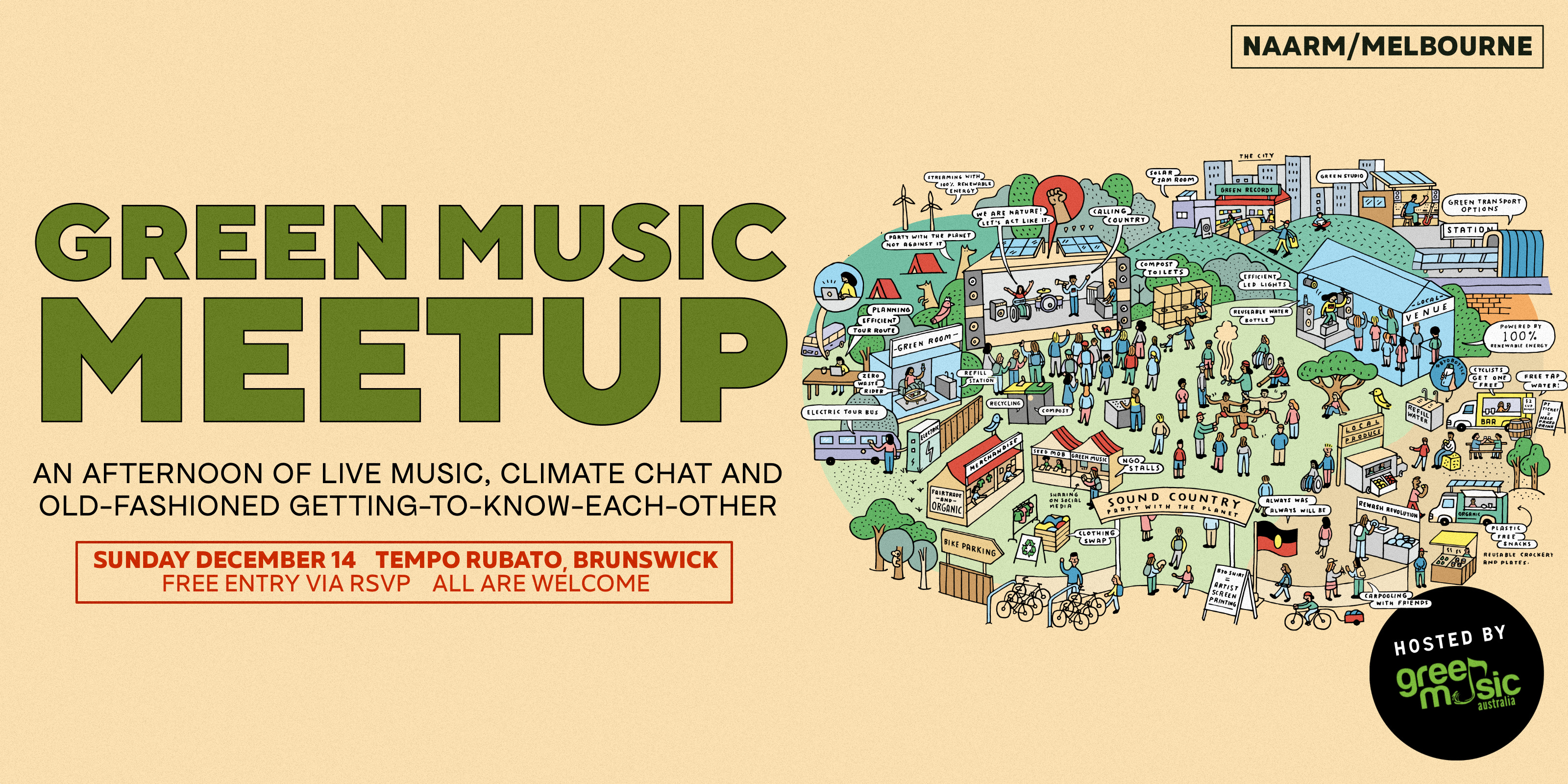
Free entry via RSVP, register here if you want to come along:
https://events.humanitix.com/green-music-meetup-naarm
Join in and talk to new people. Talk about music, talk about climate, talk about the many other crises unfolding in front of our faces, or talk about the weather, talk about footy. Whatever. Just talk to each other.
I’ll talk at you a bit but hopefully not too much.
I know I’m not meant to say this out loud but the point isn’t actually to come and get ‘schooled’ on climate stuff, though that may happen by osmosis (you’e been warned). The point is simply to come together and vibe, and feel less alone. Be with each other so that we can build the mutual support and connections we need in order to function as a collective entity on the things we care about, and not be isolated and alienated from each other and from our values.
Cool? Cool.
WEREN’T YOU DOING A PODCAST OR SOMETHING
Yes. Yes I was. Got distracted by my job.
You can still catch up on Season 1 of Why Make Music wherever you like to listen to podcasts - or watch it on Youtube. It’s a podcast where I sit with people who I think are really interesting, and we talk about why music matters. pretty basic, but actually it’s funny how rare it is for conversations about music to actually be about why it matters that we even do it. Does it matter? Why? Stick around to find out.
The update is I have recorded some new episodes - specifically with Liz Pelly, Dr Sam Whiting (again), Ella Thompson, and Alex Cameron from BAD//DREEMS - which means Season 2 is on the horizon. These audio files exist! They are here on my computer.
What’s in the way of it happening? My time / attention span, that’s what.
So - if you’d like season 2 of this podcast to happen, here’s how you can help:
I’m still looking for someone to help me out as a podcast producer (probably as a volunteer as I have no budget for this project right now) - you need to be able to do audio editing, video editing, preferably have some experience with “content” both long form and short form, and preferably feel comfortable scripting things like intros and show descriptions. This person would be an angel for me and I don’t think the person exists who would want to do this for free. But if that person is you, or you know someone who might be that person, let me know. I feel like I need a co-pilot / accountability partner in this, cos at this point in my life as a creative person I am tired of having to do anything on my own. I’ve learned that it’s more fun going on a road trip if you don’t have to be the person behind the wheel for the entire trip. I’m also just too old and too tired to do things alone any more.
If you’re a generous person with the capacity to contribute financially - cos you really want this podcast to exist and you can throw a few dollars at it, or a lot of dollars at it - obviously hit me up. Not trying to make money from this project - or any project anymore - but a bit of budget could potentially help me hire that angel who I referred to above, who may or may not exist.
That’s where I’m at with it! Just being transparent. An extra pair of hands and/or a bit of budget, would help me get this podcast up and running again, at least for a second season, or potentially as an ongoing thing. I love doing it.
Ok - onto the ramble.
Last night, I went to an event organised by Kuya Neil (of CONTENT.NET.AU, Sound School and many other things) and Joe Hardy (of sydneymusic.net, The Gate and many other things) that has my brain buzzing this morning.
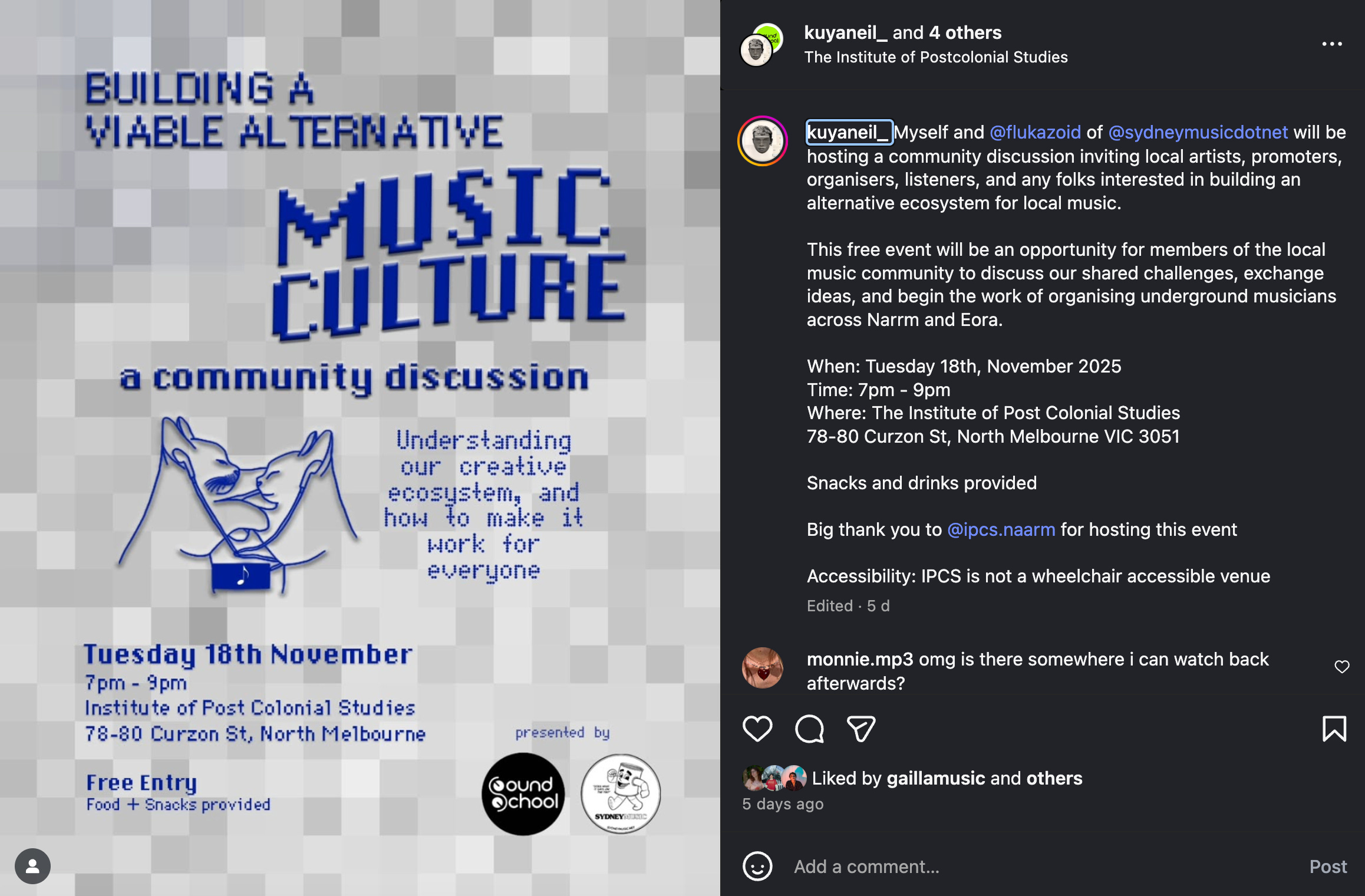
It was a community discussion on “building a viable alternative music culture.” It was announced last Thursday, and in just five days the word had circulated far. Multiple people sent it to me, a godsend in the algorithm age (thank you to those who did).
I reckon there were about 40-50 people in the room, incredibly diverse but with some things broadly in common. Amazing turnout, frankly. They were young too - at least from my vantage point as a man who is officially middle-aged. It felt like - broadly speaking - a very diverse and highly engaged set of representatives from Naarm’s actual living, messy, vibrant community music layer. People who were parts of genre scenes, artist collectives, Discord servers, indie labels, club nights, education programs, impact & advocacy groups. I knew many of them already but there were many new faces too - new to me, but not new to the work of building community, from what they had to say, how eloquent and generous and passionate they were.
What quickly became clear that what we all had in common was that we had self-selected as having a desire to want to “do music better” in the community: identifying shared problems and, maybe, just maybe, letting each other dream into existence some new or at least ‘better’ ways of doing things. Pretty energising.
Side note. I had a (older, white, male) friend tell me last week that he’s a bit tired of events saying they are gonna be “safe spaces” because there is no such thing as a ‘safe space for everyone.’ My skin temporarily started crawling but once we got talking I understood exactly what he meant. You make an event or a location or an organisation safe for some people, and in doing so other people may feel excluded or not welcome. It’s not that we shouldn’t create safe spaces - far from it - but its just about acknowledging that in creating a space that some people need, and where they feel comfortable saying what they really think, you may in that process be necessarily excluding others.
Last night’s event was definitely not a safe space for music industry executives, self-identifying “content creators”, aspiring old-school music managers, publicists and/or social media marketing experts.
This was a room that was not necessarily even interested in engaging “the music industry” at all, let alone trying to reform it. There is ‘inside work’ to be done in that sense - reforming the existing system, or perhaps more accurately, manage its decline. Sure. But the energy in this room felt like it was beyond that, wanting to move past the cognitive dissonance of trying to work within compromised systems and instead wanting to imagine radical other ways of living music. Even if it feels hard, feels sisyphean, even if it feels like we’re now starting to speak a completely different language from those people whose time and mindset is captured by ye old school music industry narratives and incentives. Like I said - energising.
It didn’t feel right to take a photo of everyone there though I wanted to because I was so in love with this room. But I did take a couple of photos of slides from Joe Hardy’s presentation - and I really liked this one:
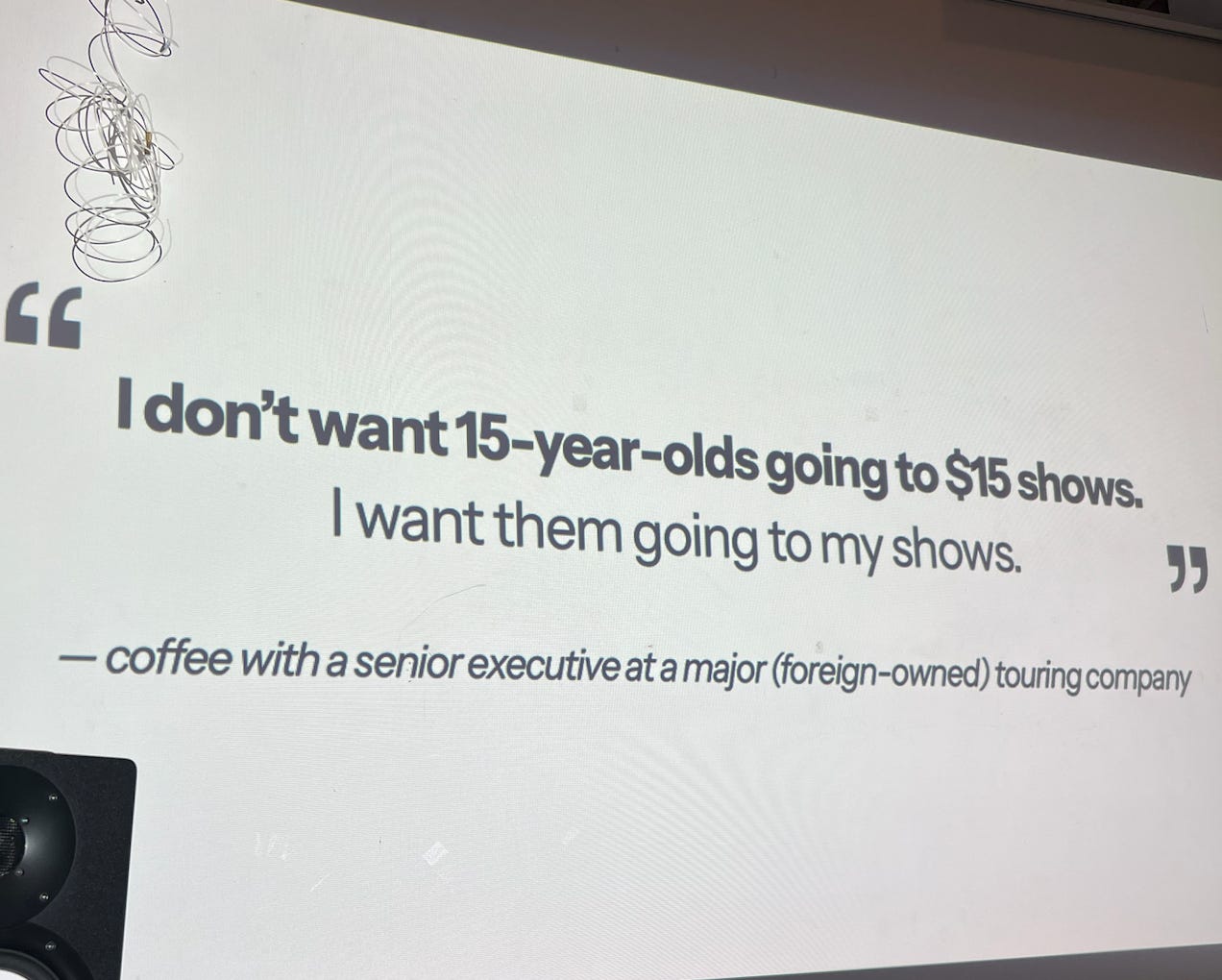
Context: Joe runs a grassroots online gig guide in Sydney, but is also pals with high level industry executives, and this quote is from someone shamelessly revealing that those “in power” in music really have no commercial incentive to support grassroots music. Popping this quote up on a wall for us all to look at, instantly made us all feel a kind of solidarity in opposition to what’s being articulated here. This quote feels intensely familiar to me as someone who has interfaced with the music industry a lot over the years. As Joe quipped: “You’d be surprised how many people working in the music industry don’t even appear to like music.”
So, inspired a bit by last night, today I want to do a few things in this email, maybe collect and coalesce some thoughts I’ve been having in recent weeks and months. As usual, this will be messy and 100% vibes-based.
Here’s what the rest of this email is:
I’m going to give a (lazy, quick) snapshot of the community music layer that I’m discovering organically through my work at Green Music Australia - some, but not all of which, I could see there right in front of my face last night - in order to hypothesise that it is stronger and more vibrant than many realise
talk about some of the challenges that perhaps they all have in common - based a little on everything I heard last night plus some of my own vibes
brainstorm a few big ideas that I think could help strengthen that network
MAPPING COMMUNITY MUSIC
Plants appear to communicate within an ecosystem using mycelium, the fungal network produced by mycorrhiza fungi. If it hasn’t already, you can expect “mycelial network” to soon become shorthand in hipster pitch decks, “alternative thinking” bro culture, web3 Discord servers & revolutionary groupchats. Nonetheless, I like the term right now because it feels sci-fi and it disorients normies.
My work at Green Music Australia - which includes trying to get a (largely vibes-based) sense of the landscape of community music in Australia - is making visible to me an interconnected network of not-for-profit or for-purpose music organisations big and small, that altogether provides a completely different snapshot of “music in Australia” to what you might see if you tune in to the ARIAs tonight.
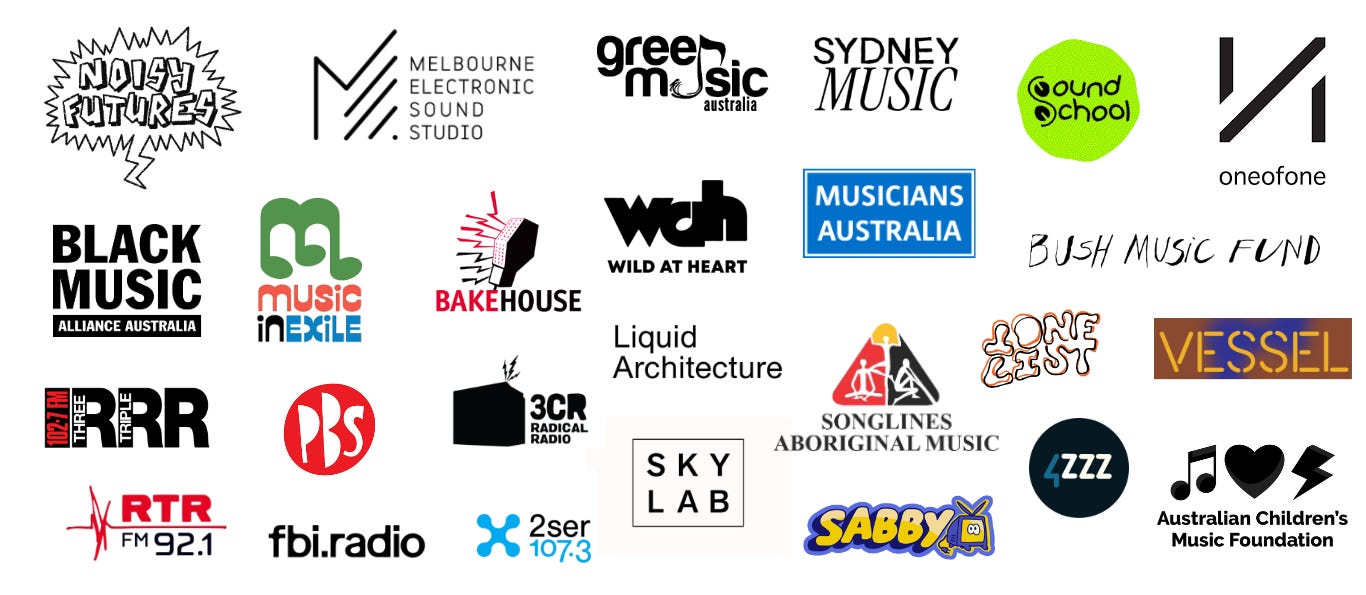
I wonder if we can imagine community music in Australia as an ecosystem where we are all plants, or groups of plants, that are plugged in to each other underground by connections that are both visible and invisible, conscious and unconscious. Whether we know it or not, we all soak up each others vibes good or bad, and that affects the health of the whole ecosystem.
Maintaining this mycelial network as a gentle and thoughtful custodian is someone’s job, or it should be, but it kind of isn’t. Whose job is it to tend the garden that allows all of this to grow? Government funding for the arts often feels like its been captured by the very commerical incentives that are the antithesis to the community-building that we need to make our communities and societies healthier, safer, greener - whether its commercial ventures like large-scale festivals getting “bailed out” during COVID, or narratives around “export” and “creating the next big thing” seem to run pretty deep in both government funding and public broadcasting institutions. Whose job is it to tend the garden?
The image above throws a lot of strange bedfellows together, but let me talk through a few of the cool groups I’ve highlighted:
Noisy Futures, fka Girls Rock Canberra, has been creating safe spaces for female, gender-non-conforming and trans kids for almost a decade, bringing music-loving kids together for “rock camps” that have less to do with trying to create the next generation of “successful artists” and more about trying to form community bonds of mutual support and safety
Melbourne Electronic Sound Studio, a not-for-profit “gym for synth nerds” that has somehow miraculously combined a handful of noble goals - preservation of historic electronic instruments; building community through music; music education and public participation in creativity - into a functioning institution now located in a ridiculously public location at Federation Square
Green Music Australia (hi), a not-for-profit national organisation providing green resources & guides for the music sector while also trying to build community and solidarity among musicians and music lovers passionate about climate action
Black Music Alliance Australia, on a mission to empower self-determination and unity representing People of African descent in the Australian music industry -member-based and managed by an all-Black committee of visionaries and changemakers dedicated to improving the Black experience in music.
Music in Exile, a not-for-profit label that also runs events and community programs, borne out of a desire to support asylum seeker & refugee musicians in Australia, now creating space for artists and musicians from marginalised cultures and trying to give them access to the ‘mainstream’ music ecosystem
Musicians Australia, an initiative of the MEAA union, which is the closest thing we have to a national musician’s union in Australia and has been spearheaded campaigns such as the drive to implement a minimum fee for live music workers
Bakehouse Studios, a vibrant community hub, rehearsal and event space that runs largely already as a not-for-profit socially motivated organisation
Our national network of community radio stations which are run by small core staff but hordes of volunteers, often taking funding from their listeners via subscriptions, generally doing the work of platforming and making visible the music and musicians that don’t cut through into mainstream/’visible’ platforms
Guts Touring, which takes rock bands on solar-powered tours into the outback to play DIY shows in remote and regional Indigenous communities, and its parent foundation Bush Music Fund which is trying to raise money to give indigenous musicians support to access “the rest of Australia” and “the music industry”
This is FAR from an exhaustive or authoritative list - it’d take months to actually try and map the “community layer’“ of music in Australia, and I’ve just reached for the orgs and groups that are on my mind or I’ve had something to do with recently.
To actually map this layer would be a fun, and probably very useful (and contested) task - if anyone wants to pay me to spend 100 days to do it, let me know haha.
But making that image up there, which took me less than half an hour, is my way of demonstrating that yes a thriving, diverse, grassroots music network exists. Now. It is not a mythic thing to strive for in the imagined wonderful future. It is a living, breathing, functioning ecosystem of organisations and individuals that is happening now and has been happening for decades. It just is not visible, to many people who consider themselves either music change-makers or simply music lovers. The industry takes up space, in reality and in our brains.
Let me take a moment to think about what these “community layer” music orgs have in common, and what they might need in terms of support - if someone was to say “its my job to tend the garden”, what would be the strategy there.
What do they have in common (broadly speaking)
Not driven by commercial incentive - even though they may engage with “the business”, and obviously they have overheads and costs, and may sell products and services - all of these orgs are either registered not-for-profits/charities or are acting in all purposes as if they are
Intentionally not trying to scale - though some of these orgs are trying to be “national community orgs” which brings with it a very specific set of challenges, and in some ways runs counter to the ‘intense localisation’ that I sometimes think is what we should be doubling down on at the moment. I’m thinking of my own org here frankly.
Inclusive and welcoming of all perspectives ( from my experience with all of these orgs, anyway)
Actively seeking to engage with or experiment with new models, new ideas.
THE CHALLENGES THESE ORGS / THIS LAYER FACES
Bringing it back to this event last night, there was a lot of space given to just putting voice to what we see as the challenges that stop us from building a healthy and vibrant music community - what is stopping us from connecting to each other, from creating and enjoying music together, stopping us from building community, driving change, all the things we want to do.
Based on that, and some thinking I’ve been doing, here is me spitballing three key challenges that feel like they keep coming up:
Funding - people still need to pay their bills and pay their rent, and the community layer relies intensely on volunteers and underpaid music workers. More established community or NFP orgs also face the challenge of relying on “project funding” vs “untied or core funding” - becoming trapped in an endless dance of trying to negotiate the criteria of grant funding bodies rather than just doing the thing that they know they are good at or need to do in order to grow community.
Visibility - even though we all know we need to not be using Instagram and social media platforms to try and organise our communities, we end up there anyway because we tell ourselves “that’s where everyone is” and because many of us are still intertwined in those platforms personally, for work or for play. How do you build community when you are relying on algorithms to keep the connections alive, to notify people about events, to reinforce your shared worldviews and shared ideas? In short: you can’t.
Interconnection / interdependence - Stronger together! It’s not about merging all of our beautiful special communities into one big “mega community” - we actually should actively resist that. It’s all about ‘groups of groups.’ Squads and gangs and small groups build their own codes of conduct, their own language, their own values and worldviews, that helps members identify themselves and each other, that helps clarify the purpose for a community even existing. But something that came up a lot last night was this ideas of cliques and scenes being dangerous and counter-productive. One participant said something along the lines of “all the people I share values with, I don’t really like the music they make. All the people who make the music I like, I don’t share any values with.” A few others talked about how genre and scene-making gets in the way of truly making broad human coalitions. How do we foster a culture of interconnection and interdependence between these groups that from one angle might not seem to have much in common - but when you dig in, actually have fundamentally nearly everything in common in terms of how they perceive music’s role in society. Again - whose job is it to tend the garden?
WHAT COULD WE BUILD TO ADDRESS THESE CHALLENGES
Just a few ideas here. I’m spitballing. 100% vibes based.
Map the community layer. I hinted at this before but I do wonder if it would be useful to map out the community / “non-profit” layer of music in Australia in a functional way. Who is out there, what are they trying to do, how many people are involved, what is their mission? Where are the connections and potential for collaboration? Who doesn’t know about each other yet - but should?
Shared calendar. Are you running a regular community event? Are you trying to get people together to talk about something / make a difference? It is fucking impossible to co-ordinate this via social media in the year 2025. What shared resource could we build that would make it easier for us all to know exactly what each other is doing, and when, and where? Because we should all be at each other’s shit. Do we need a weekly newsletter .. a Web 2.0 website... ? I want to “show up” to events like last night - I’m not talking necessarily about gigs - I’m talking about the IRL chats and gatherings where people are motivating and organising each other into alternative action. I reckon a shared calendar would help us turn up in each others communities and strengthen that “mycelial network” and interdependence. A vibrant communty cultural layer is one where everyone individual is a member of multiple communities.
Funding platform. I think there is untapped philanthrophy for the community layer of contemporary music. Something I hear people talk about is this coming redistribution of ‘big wealth’ where Boomers are gonna pass away and give their money to Gen X - and Gen X has a different idea about what to do with their accumulated wealth than their parents and grandparents did. It’s an interesting theory that I don’t totally buy, but you can make the case that in coming years we’re going to have a lot more cashed-up middle aged people who understand the intrinsic value of the community layer of music because they were part of it - they listened to 3RRR, they went to Meredith, they love Amyl & the Sniffers. I’m curious how to get these people to fund the community layer directly, and reduce the NFP / community music layer’s reliance on government funding with is a) unreliable b) often coded with commercial interests/narratives. Is there space in our ecosystem for an org whose sole purpose is to “find the money” i.e. the well-intentioned rich people, and engage them to fund the community layer of music. Does this org exist? Or is every NFP / community org just floundering around trying to tackle fundraising themselves with their underresourced and perhaps not fully ‘fundraising-aware’ skill sets? How is that going for everyone?
Basic income. I mean one cool idea could be we just tax the super-rich - and/or tax the fossil fuel companies and/or tax Spotify and the other tech companies who largely avoid paying local taxes - and redistribute a very small amount of that money to fund cultural activity with a focus on community building, starting with just some no-strings-attached basic income payments to already working artists? Just a fuckin thought.
THE FUTURE OF MUSIC IS NON-PROFIT? DISCUSS
I do find myself saying this to people, again often when I’m stretching for some pithy statement that I think might cut through to my fellow normies. “The future of music is non-profit.”
Is it though? Some people I say this too scoff and say “you wish.” Yep. I wish. Dude, I’m manifesting, and you should too. Again, I’m 100% vibes based and no doubt some industry worker and/or way-smarter-than-me academic or economist can slide into my replies with a rebuttal and tell me how the future of music is actually more fucked, more exploitative, more depressing, than the present of music … but here’s a bit of a theory that I am working with these days, to try and hold on to a more positive vision:
I think with the standard music economic systems basically in free-fall (i.e. live music being decimated by changing behaviours, over-reliance on alcohol, and generational issues over venue ownership and real estate; digital music being completely devalued as a commodity and instead becoming a vessel for surveillance and data harvesting; yadda yadda) and with people yearning for connection, antidotes to loneliness and alienation, and also yearning for a way to buy into new ideas or experiment with alternative ways of ‘living and thinking’ - I think culture steps in, in the years to come, to become the playground and living breathing space where we can do that.
As people young and old, but especially young, realise that the most urgent thing they need to worry about is not how to get into the housing market but actually how to save humanity from itself by addressing deep systemic issues and the symptoms of them (wealth inequality, colonisation, climate crisis, war and genocide)… I think perhaps that means we have a creative class / cultural class coming through that is much more focused on using music as a tool to build community and solidarity - focusing on music as participatory, as social, as imaginative, as emancipatory - than using music to “build career.”
Put frankly, less and less of us believe in the myth that a music career is even possible let alone realistic, so those of us in a position to do so - because day jobs, because privilege, because whatever - are turning our attention away from music industry narratives, removing consent from them, and starting to think and dream more about music as a public good.
So - as people awaken to this idea - creative people internalise it and it inoculates them against commercial incentives - governments internalise it and start to shift funding away from “music as export” or “music as commodity” to “music as public health outcome” or “music as community layer” - philantropists internalise it and realise that they should be funding interconnected networks of small community groups and squads rather than funding vast capital-A Art institutions (I might be dreaming here) — as this shift happens in real time, what infrastructure is in place or needs to be in place? Who is gonna tend the garden and how?
Ok quite a rambly and potentially unfocused one this week - as if they aren’t all like that - but as always I think that’s better than not writing anything. And I write these in order to understand what I think, so it’s largely for me not you. (soz)
But if you got something out of it, let me know, if you have something to add or contribute, let me know. And remember that my thoughts and feelings are 100% vibes based so I take zero personal responsibility for getting facts wrong, reading the room poorly, putting my foot in my mouth, etc. This is the great “get out of jail free card” that comes with being 100% vibes-based in my research and thinking, and is exactly why I’ll never do a PhD even though many of you have suggested that I do haha. Bless you academics but I do not have the patience or the rigour for it.
Sending love to wherever you are from where i am (my kitchen table)
Tim
Separate from the thread about non-diminishable public goods, I'd be remiss to not post about the gig this weekend by my kids punk band Riot Baby (deets here: https://events.humanitix.com/riot-baby-bad-decisions-single-launch-w-charlie-needs-braces-northcote-uniting-hall). We think a lot about how to build an alternative music culture, create spaces to connect local families to original, local music.
We're lucky to get quite a lot of council festival bookings, and we've been going to folk music camps a bunch too in the last few years, which are both lovely spaces for discovery and to show what we do, but headline gigs are really hard!
In this case, we've got some funding from Darebin Council to cover some extra advertising and mean that we can offer artists guarantees, but it's a struggle to get people to buy pre-sales as always!
Economist/musician here (maybe more accurately musician/economist these days) and I think you’d find that most economists wouldn’t quibble with your definition of music as a public good as it is non-excludable, and non-rivalrous. Especially in these days of streaming, it’s effectively zero-marginal cost.
I used to work in infrastructure policy, which is another type of non-diminishable public good, and it’s astounding how well some of those frameworks apply to music. In other industries, we have regulators, unions, consumer advocates and consumer protection bodies to keep an eye on the industry, but no one seems to be looking at this in music in a systematic way. Creative Australia does a study every year, I want a damn senate inquiry and an ACCC investigation!